
Shopping Cart
- Product analysis
- 0 likes
- 397 views
- 0 comments
- Fritz 21, Chessbase, Chess Software, Chess Program, Chess Analysis, Chess Training, Chess Engine, Fritz 20, Fritz 19, Stockfish, Komodo Dragon, Leela Chess Zero, Chess, Chess Training Software
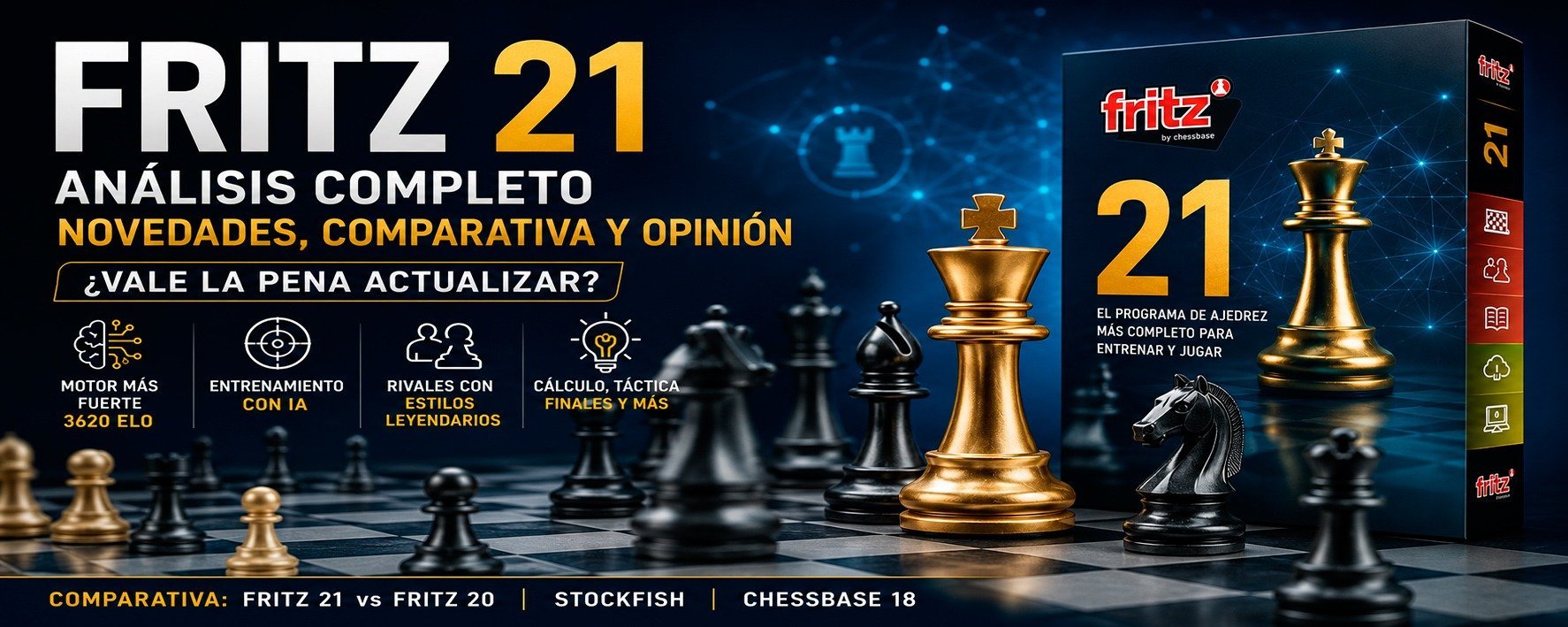
Fritz 21: New Features, Comparison and Review. Is It Worth Upgrading?
Fritz 21 arrives as a new version of ChessBase's classic chess program, but this time the novelty isn't just a more powerful engine. It feels like ChessBase has aimed to transform Fritz into a more complete, visual, and player-friendly training tool.
In this review, we'll see what's new in Fritz 21, how it differs from Fritz 20 and previous versions, whether it's worth upgrading, how it compares to Stockfish, ChessBase 18, Komodo Dragon, and Leela Chess Zero, and what type of player it might be most beneficial for.
The goal isn't to provide a dry technical spec sheet, but rather a useful comparison for those considering whether to buy Fritz 21, upgrade from a previous version, or continue using free tools.
What Is Fritz 21?
Fritz 21 is a chess program for Windows developed by ChessBase. For many years, Fritz has been one of the best-known programs for playing against the computer, analyzing games, and training chess at home.
Unlike ChessBase, which is more focused on databases, opening preparation, and professional analysis, Fritz is primarily designed for playing, practicing, training calculation, reviewing mistakes, and improving in a more practical way.
The key difference is this: Stockfish tells you which move is best; Fritz tries to help you learn why.
Therefore, Fritz 21 shouldn't be considered solely as a chess engine. Today, there are many very strong engines, even free ones. What's interesting about Fritz 21 is its comprehensive environment: games against different styles, training, progressive help, analysis, tactics, endgames, and an interface designed for users who want to improve.
If you are looking for other tools to train, analyze games, or prepare openings, you can also visit our chess software section, where you will find different solutions for players of all levels.
A Brief History: Why Fritz Is Such a Well-Known Chess Program
Fritz isn't a new program. It's one of the most recognized brands in modern chess software. For years, it was synonymous with playing against the computer, analyzing games, and checking variations from home.
Before online platforms and free engines became so prevalent, many players used Fritz as their primary training tool. For many enthusiasts, it was their first serious experience with computer-assisted analysis.
Over the years, Fritz evolved. Initially, its main appeal was the engine's power. Later, as engines reached levels virtually unattainable for any human, the value shifted more towards the user experience and training tools.
Fritz 21 follows this trend. It doesn't aim to be merely "stronger," but rather more useful for the player.
| Version | Approximate importance |
|---|---|
| Early versions of Fritz | They popularized analysis and playing against the computer at home. |
| Fritz 5 / Fritz 8 | Versions fondly remembered by many club players and fans. |
| Fritz 12-15 | Interface improvements, analysis and compatibility with the ChessBase ecosystem. |
| Fritz 18-20 | Greater focus on training, playing styles, and a more visual experience. |
| Fritz 21 | More strength, more training features, and a more practical approach for the player. |
Main New Features of Fritz 21
1. Highest playing strength: 3620 Elo
ChessBase announces that Fritz 21 has reached approximately 3620 Elo points, an improvement of about 40 Elo points over the previous version.
This sounds spectacular, but it needs to be put into context. For any human player, even strong club players, this strength is more than enough. The Elo improvement will be most noticeable in in-depth analysis, complex positions, and comparisons between engines.
But, frankly, if you're only looking for brute strength, there are free engines like Stockfish that already offer an extraordinary level of performance. Fritz 21's value lies not only in its power but also in its comprehensive set of training features.
2. AI-Assisted Training
One of the most interesting new features is AI-assisted training. Fritz 21 doesn't just show you the best move all at once; it can give you more gradual hints.
This is important because learning chess isn't just about looking at an engine's evaluation. If the program gives you the answer immediately, you often don't learn. On the other hand, if it guides you little by little, it forces you to think.
For club players, students, and amateurs who study on their own, this feature can be very useful. It's more like working with a coach who guides you than simply consulting a machine that calculates.
3. Historical Opponents and Playing Styles
Fritz 21 lets you play against opponents inspired by great players from history, such as Lasker, Tal, Fischer, or Karpov. The idea isn't just to change the opponent's name, but to try and replicate different playing styles.
- Aggressive style: ideal for practicing defense and tactical calculation.
- Positional style: useful for learning long-term plans.
- Solid style: forces you to gradually create advantages.
- Risky style: generates more complex and dynamic positions.
- Changing style: helps train endgames and simplified positions.
This makes training with Fritz more like playing against real people. In a tournament, not all opponents play the same way, and that variety is good for improvement.
4. Calculation Training
Calculation is one of the biggest problems for many players. Knowing openings isn't enough: you have to calculate variations, review candidate moves, and avoid impulsive moves.
Fritz 21 improves calculation training and combines it with time-pressure situations. This feature can be especially useful for players who lose games due to tactical errors or failing to calculate a variation until the end.
For club players, this function can be more practical than the engine's Elo rating boost. Most games aren't lost because the opponent knows twenty theoretical moves, but rather due to a miscalculation, a poorly defended piece, or a simple tactic that escapes us.
5. Bullet Training
Bullet Training mode is designed to improve decision-making speed. It doesn't replace in-depth study, but it helps train reflexes, intuition, and time management.
For players who frequently run out of time, this feature can be quite useful. Many games aren't lost due to a lack of knowledge, but rather due to poor decisions made when time is running out.
6. Táctica, finales y Freestyle Chess
Fritz 21 also includes training in tactics and endgames. This is important because many players study openings but neglect endgames.
Furthermore, it incorporates training related to Freestyle Chess, a modality that is gaining popularity and forces players to think from the very first move, without relying so heavily on memorized theory.
This is interesting because more and more players want to train chess in a less repetitive way. Freestyle Chess forces players to understand the pieces, plans, and coordination from the outset.
What Improvements Will You Actually Notice?
The announced new features are one thing, but what a player actually notices when using the program is another. In day-to-day use, the most important aspect of Fritz 21 isn't that the engine is slightly more powerful, but rather that the training is more varied.
If you play a game against Fritz, review your mistakes, do calculation exercises, and retry a position, the experience is much more comprehensive than simply opening an engine to view a line of analysis.
This is especially useful for players who don't have a coach or who want to supplement their lessons with practice at home.
| Regular use | What does Fritz 21 offer? |
|---|---|
| Analyze one's own game | It allows you to review mistakes, understand critical moments, and compare decisions. |
| Training tactics | It helps to work on calculations, patterns, and candidate plays. |
| Practice endings | Useful for improving technique and confidence in simplified positions. |
| Play against the computer | More entertaining thanks to different styles and levels. |
| Improve time management | Rapid training helps you make better decisions under pressure. |
The Evolution of Fritz: From Classic Versions to Fritz 21
To determine if an upgrade is worthwhile, it's not enough to simply compare Fritz 21 with Fritz 20. Many players still use much older versions, such as Fritz 12, Fritz 15, Fritz 18, or Fritz 19. In those cases, the difference can be much more noticeable.
Fritz has changed significantly over the years. Early versions were primarily programs for playing against the computer and analyzing games. Modern versions, however, have added more training features, more visual aids, and a more learning-oriented experience.
Fritz 8
Fritz 8 was a very popular version and fondly remembered by many chess enthusiasts. At the time, it was impressive to be able to analyze games at home with such a powerful and user-friendly program.
Today, however, the difference with Fritz 21 is enormous. Not only in engine power, but also in interface, compatibility, training functions, analysis, visual aids, and overall experience.
Upgrade from Fritz 8? Yes, without a doubt. The leap is gigantic.
Fritz 12
Fritz 12 was another widely used version in clubs, homes, and schools. It already offered a fairly mature experience for playing and analyzing, but it still belongs to a very different era of chess software.
Upgrading from Fritz 12 to Fritz 21 will bring you a more modern interface, significantly improved analysis capabilities, and, above all, many more training features.
Upgrading from Fritz 12? Highly recommended, especially if you plan to use the program regularly.
Fritz 15
Fritz 15 is closer to the modern Fritz concept, but it still falls short of what Fritz 21 offers in terms of training, visual style, and ease of use.
If you have Fritz 15 and are still using it, it can probably still be useful for analysis, but Fritz 21 offers a much more complete experience.
Upgrading from Fritz 15? Recommended if you want a more up-to-date, user-friendly, and training-oriented tool.
Fritz 18
Fritz 18 already included many modern features. For many players, it remains a perfectly adequate version. However, Fritz 21 improves the overall experience, training, engine performance, and is geared towards players who want to practice.
Upgrading from Fritz 18 isn't as "essential" as it was with Fritz 8 or Fritz 12, but it's still highly recommended if you practice frequently.
Fritz 19
Fritz 19 is still a very usable version, but Fritz 21 offers enough improvements to make the upgrade worthwhile. The difference is most noticeable in training, game styles, the interface, and the latest features.
If you have Fritz 19 and use it for both gaming and training, upgrading to Fritz 21 could be a good decision.
Fritz 20
Fritz 20 is the most delicate comparison. If you have this version and don't use it much, you might not need to upgrade immediately. However, if you use Fritz every week as a training tool, Fritz 21 could offer some significant improvements.
The Elo rating increase won't be the most important factor. What matters is a more refined experience, more comprehensive training, and new or better-integrated features.
Quick Comparison of Earlier Fritz Versions
| Version | What did it offer at the time? | Upgrade to Fritz 21? |
|---|---|---|
| Fritz 8 | Very popular, ideal for playing and analyzing in its time. | Yes, an update is practically mandatory. |
| Fritz 12 | Widely used in clubs and homes, a good interface for its time. | Yes, highly recommended. |
| Fritz 15 | More modern, but without many current features. | Yes, recommended. |
| Fritz 18 | A fairly modern and still useful version. | Recommended if you train often. |
| Fritz 19 | Good version, with very up-to-date features. | Yes, if you want training and experience improvements. |
| Fritz 20 | Very recent version and still very valid. | It depends on the use. |
Comparison: Fritz 21 vs Fritz 20
| Feature | Fritz 20 | Fritz 21 |
|---|---|---|
| Engine power | Very high | Stronger, approx. 3620 Elo |
| Elo Improvement | Previous version | +40 Elo points approx. |
| AI Training | Present in previous roles | More focused on clues and learning |
| Playing styles | Interesting | More elaborate and realistic |
| Calculation | Good | Improved, with a more practical focus |
| Interface | Modern | More renewed and direct |
| Update? | It is still valid | Recommended if you train often |
If you already own Fritz 20, whether you upgrade will depend heavily on how much you use it. If you use it weekly for training, analyzing your games, or working on positions, then Fritz 21 makes sense. If you only open it occasionally, it might not be an urgent purchase.
Comparison: Fritz 21 vs Fritz 19
Many players don't upgrade every year. That's why comparing it to Fritz 19 can be even more interesting than comparing it to Fritz 20.
If you're coming from Fritz 19, the jump to Fritz 21 is more noticeable. This isn't just due to the engine's power, but also because of the accumulated improvements in training, the interface, play styles, and practical features.
| Aspect | Fritz 19 | Fritz 21 |
|---|---|---|
| Playing strength | Very high | More updated and powerful |
| Training | Correct and useful | More complete and guided |
| Visual experience | Good | More modern |
| Recommendation | It's still usable | Recommended update if you use it for training |
In summary: I see updating as more justifiable from Fritz 19 onwards. From Fritz 20 onwards, it depends more on actual usage.
Fritz 21 vs Stockfish
This comparison is unavoidable. Stockfish is free, incredibly powerful, and a global leader in analysis.
So why buy Fritz 21?
The answer is simple: because they don't compete in exactly the same areas.
| Use | Stockfish | Fritz 21 |
|---|---|---|
| Pure analysis | Excelente | Very good |
| Guided training | Limited | Very complete |
| Playing against human styles | It's not their strong point. | Yes |
| Ease for the fan | It depends on the interface used | Very comfortable |
| Price | Free | Paid |
If you just want to know the best move, Stockfish might be enough. If you want to train more comfortably, play games tailored to your skill level, and receive guidance along the way, Fritz 21 makes more sense.
A simple way to summarize it would be this: Stockfish is an excellent tool for analysis; Fritz 21 is a more comprehensive tool for training.
Fritz 21 vs ChessBase 18
It's also common to compare Fritz with ChessBase, but they are programs designed for different uses.
ChessBase 18 is more focused on databases, opening preparation, finding model games, preparing against opponents, and professional work.
Fritz 21 is more focused on playing, training, calculating, practicing tactics, working on endgames, and improving more directly.
| Necesidad | Mejor opción |
|---|---|
| Jugar contra el ordenador | Fritz 21 |
| Entrenar cálculo | Fritz 21 |
| Preparar aperturas con muchas partidas | ChessBase 18 |
| Gestionar bases de datos | ChessBase 18 |
| Uso escolar o de club | Fritz 21 |
| Preparación profesional completa | ChessBase 18 + Fritz 21 |
The ideal approach for an advanced player isn't to choose one or the other, but to understand what each program is for. ChessBase is better for preparing and organizing information. Fritz 21 is better for training and playing.
Fritz 21 vs Komodo Dragon
Komodo Dragon is another well-known engine, especially valued by many traders for its analytical style and for offering different approaches to Stockfish. It's a very interesting tool for analyzing complex positions and comparing ideas.
However, as with Stockfish, Komodo Dragon is primarily valued as an engine. Fritz 21, on the other hand, offers a more comprehensive training environment.
| Aspecto | Komodo Dragon | Fritz 21 |
|---|---|---|
| Tipo de producto | Motor de análisis | Programa completo de juego y entrenamiento |
| Análisis profundo | Muy fuerte | Muy fuerte |
| Entrenamiento práctico | Depende de la interfaz usada | Más directo y accesible |
| Uso para aficionados | Interesante si se sabe configurar | Más sencillo para empezar |
For pure analysis, Komodo Dragon can be an excellent tool. For a user who wants to play, practice, and train without too much hassle, Fritz 21 is more convenient.
Fritz 21 vs Leela Chess Zero
Leela Chess Zero, also known as Leela or LCZero, is a neural network-based engine that popularized a different way of understanding many positions. Its style often feels more human in certain types of positions, especially in positional sacrifices, initiative, and piece coordination.
However, Leela also requires some configuration and isn't always the easiest option for the average user. Fritz 21, on the other hand, is designed to offer a more structured, comfortable, and guided experience.
| Aspecto | Leela Chess Zero | Fritz 21 |
|---|---|---|
| Tipo | Motor neuronal | Programa completo |
| Configuración | Puede ser más técnica | Más sencilla para el usuario general |
| Estilo de análisis | Muy interesante y diferente | Más orientado a uso práctico y entrenamiento |
| Para aprender | Útil si sabes interpretar análisis | Más accesible |
Leela is very useful for comparing analyses and studying chess at an advanced level. Fritz 21 is more suitable if you're looking for a ready-to-use training tool.
What Rating Level Is Fritz 21 Best For?
Fritz 21 can be useful for a wide range of skill levels, but not everyone will benefit from it in the same way. An absolute beginner can use it, but might not take full advantage of all its features from day one. A club player, on the other hand, can get much more out of the calculation training, game review, and playing styles.
| Nivel aproximado | Recomendación |
|---|---|
| 0-1200 Elo | Puede ser útil, pero conviene combinarlo con clases, libros básicos o cursos de iniciación. |
| 1200-1800 Elo | Muy recomendable para entrenar cálculo, táctica y revisión de partidas. |
| 1800-2200 Elo | Excelente como herramienta de apoyo, especialmente para análisis y entrenamiento práctico. |
| 2200+ Elo | Interesante como complemento, aunque probablemente se combine con ChessBase, bases de datos y motores externos. |
Who Should Buy Fritz 21?
- Club players who want to improve practically.
- Hobbyists who want to play against the computer and learn.
- Children and teenagers who already know the rules and want to practice.
- Chess instructors looking for a visual tool for classes.
- Players who want to practice calculations and endgames.
- Users of older versions of Fritz.
- People who want a more comprehensive program than a simple free engine.
When Is It Not Essential?
Fritz 21 may not be an urgent purchase if:
- You already have Fritz 20 and you barely use it.
- You only analyze games occasionally.
- Your absolute priority is to use a free engine.
- You already work primarily with ChessBase and databases.
- You don't need guided training or to play against the program.
Is It Worth Upgrading to Fritz 21?
| Tu versión actual | Recomendación |
|---|---|
| Fritz 8 o anterior | Sí, actualización totalmente recomendable. El cambio es enorme. |
| Fritz 12 | Sí, muy recomendable por interfaz, fuerza y entrenamiento. |
| Fritz 15 | Sí, recomendable si quieres una versión moderna. |
| Fritz 18 | Sí, especialmente si entrenas con frecuencia. |
| Fritz 19 | Sí, el salto ya es interesante. |
| Fritz 20 | Depende: recomendable si usas Fritz para entrenar varias veces por semana. |
| No tienes Fritz | Sí, Fritz 21 es una buena puerta de entrada al ecosistema ChessBase. |
My recommendation would be clear: if you're coming from Fritz 18 or earlier, upgrading makes a lot of sense. If you're coming from Fritz 19, I also recommend it. If you're coming from Fritz 20, it depends a lot on your usage. If you train often, then yes. If you only use it once a month, you might be able to wait.
Is Fritz 21 Worth Buying in 2026?
Yes, provided you value it as a training tool and not just an analysis engine. In 2026, buying a paid chess program solely for the engine's power makes less sense than it did years ago, because there are excellent free engines available.
But Fritz 21 offers something different: an organized and convenient way to train, play, analyze, practice calculation, and work with different playing styles.
For a club, an academy, a coach, or a player studying at home, it could be a worthwhile purchase. For someone who only wants to look at a specific move, it's probably unnecessary.
Best Things About Fritz 21
- Very powerful engine, rated around 3620 Elo.
- Smarter and more progressive training.
- Historical rivals with different styles.
- Good tool for calculations and time pressure.
- Tactical and endgame training.
- More fun than analyzing solely with an engine.
- Very useful for club players and coaches. More modern and straightforward interface. A good option for those who want to train without too much hassle.
Weak Points of Fritz 21
- If you're only looking for pure analysis, Stockfish is free.
- The Elo rating improvement won't be noticeable for most players.
- It's not a substitute for ChessBase for working with large databases.
- Some online features may require a ChessBase account.
- If you have Fritz 20 and don't use it much, the upgrade isn't essential.
- For advanced users, it may be necessary to combine it with other tools.
Recommended Requirements
| Element | Recommendation |
|---|---|
| Operating system | Windows 10 o Windows 11 de 64 bits |
| RAM | 8 GB minimum, 16 GB is better |
| Processor | Modern multi-core processor |
| Internet | Recommended for online features and ChessBase accounts |
As with any analysis software, the better the computer, the easier it will be to work with complex positions. For normal club player use, a top-of-the-line computer isn't necessary, but having a modern setup is advisable.
Frequently Asked Questions About Fritz 21
Is Fritz 21 better than Stockfish?
As a pure engine, Stockfish remains a very strong and free benchmark. But Fritz 21 offers a more complete experience for training, playing, and learning.
Is it suitable for beginners?
Yes, although a complete beginner might not be able to use all its features from day one. It's especially interesting for players who already know how to move the pieces and want to improve.
Is it suitable for clubs and schools?
Yes. For coaches, clubs, and academies, it can be useful because it allows you to demonstrate positions, train calculation, play against different styles, and work on endgames.
Does it replace ChessBase?
No. Fritz 21 and ChessBase are complementary. Fritz is better for playing and training; ChessBase is better for databases and advanced preparation.
Is it worth it if I already have Fritz 20?
It depends on your usage. If you frequently use Fritz as a trainer, then it might be worthwhile. If you only open it occasionally to analyze a game, the update isn't urgent.
Is that enough for a club player?
Yes. For a club player, Fritz 21 has more than enough power and features. The engine is extremely strong, and the training tools are more than sufficient for working on games, tactics, endgames, and calculations.
Is it only for advanced players?
No. It can also be useful for amateurs and students, provided it's used systematically. The important thing is not to just watch the best play, but to try to understand the ideas behind it.
Personal Opinion
My impression is that Fritz 21 isn't just trying to compete in the race for the strongest engine. That battle, for many users, is no longer so important.
What's interesting about Fritz 21 is that it tries to be more useful to the player. It doesn't just calculate; it offers a more engaging way to train, one that's closer to a real game.
For a club player, an instructor, or an amateur looking to improve, this is invaluable. We don't always need the computer to tell us the best move in half a second. Often, we need a tool that forces us to think more deeply.
The great strength of Fritz 21 is that it doesn't just focus on "I'm stronger." It tries to offer context, practice, and variety. And that, for learning chess, can be more important than a few extra Elo points.
Conclusion: Should You Buy Fritz 21?
Fritz 21 is an interesting upgrade, especially if you're coming from older versions or if you use the program regularly for training.
Its engine is stronger, the interface is more modern, and the training features are better geared towards the player. But its main strength isn't its 3620 Elo rating; it's transforming that power into a more useful experience for learning chess.
If you only want pure analysis, you can use Stockfish. If you want to train, play, practice calculation, work on endgames, and face varied styles, Fritz 21 is a much more complete option.
In short: Fritz 21 is worthwhile if you want to use it as a chess trainer, not just as an analysis engine.
If you're coming from Fritz 8, Fritz 12, Fritz 15, or Fritz 18, the upgrade is definitely recommended. If you already have Fritz 19, it also makes a lot of sense if you train frequently. If you already have Fritz 20, it will depend on how often you train. And if you don't have Fritz, this version is a good entry point to start working with a complete, visual chess program designed for improvement.
If, after reading this review, you would like to learn more or purchase the program, you can visit the complete Fritz 21 product page. We also recommend exploring our chess software category to compare other available options.
Comments (0)